Fake Gambling Games: A Plain Guide
Fake gambling games are casino games played with worthless credits. Same mechanics, same tension, zero money. Here is what they are actually good for — and what they cannot tell you.
What Counts As A Fake Gambling Game?
Any casino-style game where the balance has no cash value. In practice there are three categories, and they are not the same thing:
- Provider demo modes — the real slot or table game, published by the studio that made it, running on credits you cannot buy or cash out. Usually accurate to the real game, and usually geo-blocked in a lot of countries.
- Social casinos — apps that sell coin packs. The coins cannot be withdrawn, but real money does change hands, and the games are often tuned to feel more generous than their real-money equivalents.
- Free simulators — sites like this one, where there is nothing to buy at all and no payment method exists anywhere on the platform.
The distinction matters. A social casino has a commercial interest in how a session makes you feel; a demo has a commercial interest in you liking the game enough to deposit. It is worth knowing which one you are looking at.
Why People Play With Fake Money
- To learn a game before it costs anything. Blackjack basic strategy, roulette bet types, how a Mines multiplier scales — all cheaper to learn here.
- To see volatility honestly. A hundred free Crash rounds show you how many die below 2× far more convincingly than any article.
- To test a system and watch it fail safely. Martingale is very persuasive on paper. Run it for two hundred rounds on fake money and you will meet the streak that breaks it, at no cost.
- To scratch the itch without the cost. For some people this is genuinely enough, and that is a good outcome.
- Because the games are fun. No deeper reason required.
What Fake Games Cannot Tell You
This is the part usually left out. Free-play results do not predict real-money results — not because anything is rigged, but because independent random outcomes have no memory and your simulated hot streak is not a signal. Worse, demo and simulator sessions tend to leave people with an inflated sense of how often they win, simply because losing nothing feels different from losing money.
There is also a documented pattern worth knowing about: research into simulated gambling has repeatedly found that free-play games can act as a stepping stone toward real-money play, especially for younger players, and that people often perform better in demo mode than they later do with money on the line. Whether that is tuning, attention, or just the absence of pressure, the effect is real. Treat a good free session as entertainment, not evidence.
And the structural point: real casino games carry a house edge. Over a large number of rounds, the operator's expected return is positive and yours is negative. A game that feels beatable for an hour is still designed not to be over a year.
Fake Gambling Games vs Real Gambling
| Free simulator | Real-money casino | |
|---|---|---|
| Stake | None | Your own money |
| Prize | None | Real winnings |
| Account required | No | Yes, with identity verification |
| House edge | Simulated, shown openly | Real, and it applies to your money |
| Legally gambling | No | Yes, and restricted in many places |
| Can you lose money | No | Yes |
Which Ones To Try First
- Dice — the clearest view of odds versus payout you will find anywhere.
- Mines — adds the one decision that matters: when to stop.
- Crash — the same decision, under time pressure.
- Blackjack — the one game where your choices genuinely move the numbers.
- Plinko — fire off a hundred balls and watch a bell curve build.
Play Them All Free
Mines
Fake Stake Originals
Plinko
Fake Stake Originals
Crash
Fake Stake Originals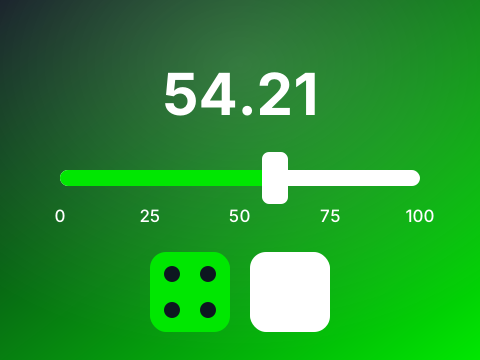
Dice
Fake Stake Originals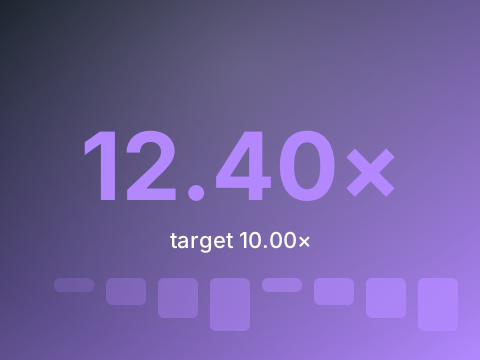
Limbo
Fake Stake Originals
Coin Flip
Fake Stake Originals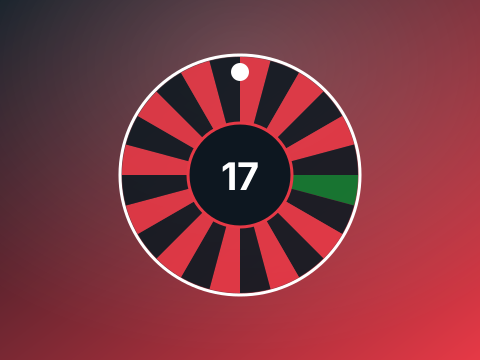
Roulette
Fake Stake Originals
Blackjack
Fake Stake Originals
Keno
Fake Stake Originals