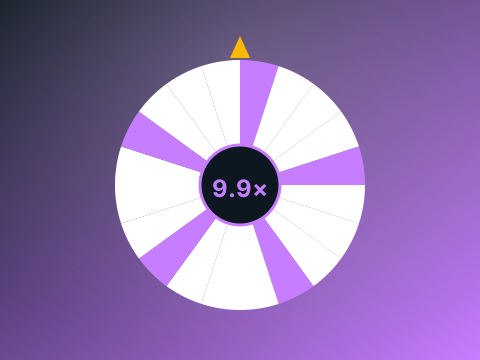
Free Limbo Game — Set Your Multiplier
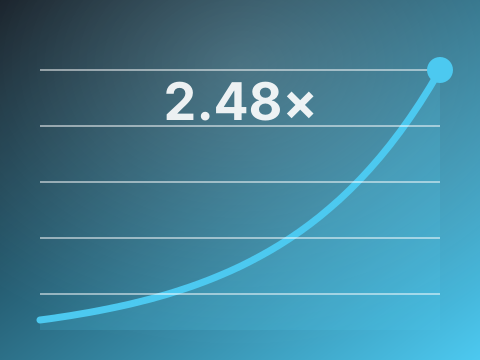
Free Limbo with fake money. Name the multiplier you want, press Bet, and win instantly if the roll goes higher. Win chance updates as you type, targets run from 1.01× to as high as you dare.
Virtual credits only. Limbo is Crash without the waiting — the result is drawn the instant you press Bet.
18+. New players only. Min deposit $30, 40x wagering. Full terms apply at Rainbet. Bonus details
Limbo In One Sentence
Limbo is Crash with the waiting removed. Instead of watching a curve climb and deciding when to eject, you declare your exit point up front and the game resolves instantly. Higher than your target, you win. Lower, you do not. It is the fastest game on the site and the most efficient way to see how brutal a big multiplier target really is.
The underlying distribution is identical to Crash: the chance of a result reaching any multiplier is 99 divided by that multiplier. What Limbo removes is the emotional part — the moment where a rising number talks you out of your plan.
Limbo Win Chance By Target
| Target | Win chance | Roughly |
|---|---|---|
| 1.10× | 90.00% | 9 rounds in 10 |
| 2.00× | 49.50% | 1 in 2 |
| 5.00× | 19.80% | 1 in 5 |
| 10.0× | 9.90% | 1 in 10 |
| 100× | 0.99% | 1 in 101 |
| 1,000× | 0.099% | 1 in 1,010 |
A thousand-times target sounds thrilling until you see the right-hand column. At one round per second, you would expect to wait about seventeen minutes for a single hit — and that is the average, not a guarantee.
What Limbo Is Good For
Because it resolves instantly, Limbo is the best game here for building an honest sense of what rare outcomes actually cost. Set a 100× target and run fifty bets. Count the hits. The gap between how a 1% chance feels and how it behaves is the single most expensive misunderstanding in gambling, and this is a free way to close it.
It is also the most direct comparison to Crash — same maths, different presentation. Playing both back to back shows how much of the appeal is in the packaging rather than the odds.
How Limbo Multipliers Are Generated
Every round draws a uniform random number between 0 and 1, and the result multiplier is 0.99 divided by (1 minus that number). That single line produces the entire distribution: values just above 1.00× are common because most of the range maps to them, and enormous values are rare because only a sliver of the range does.
The 0.99 is the house edge, and it is the only reason the game is not break-even. Replace it with 1.00 and every target on the board would return exactly your stake over the long run — which is precisely why no operator uses 1.00.
Because the draw is uniform and independent, nothing about round n tells you anything about round n+1. Sequences that look like patterns — three low results then a spike, or a run of near-misses — are what randomness actually looks like at small sample sizes. Run two hundred bets here and the shape becomes obvious.
Common Limbo Strategies And Why They Fail
The two systems you will meet everywhere are low-target grinding and high-target chasing, usually dressed up with a progression on top.
- Low-target grinding — set 1.10× and win 90% of rounds. Feels like a job with a salary until the 10% arrives in a cluster, which it eventually will, and each loss costs ten wins to recover.
- High-target chasing — set 100× and wait. Expected value is identical, but the bankroll needed to survive a normal dry spell is far larger than most players allow for.
- Martingale on Limbo — double after each loss at a 2× target. A run of eight losses happens about once in every 250 rounds, and by then you need 256 times your original stake.
- Alternating targets — switching between high and low based on recent results. This is the gambler's fallacy with extra steps; the distribution does not know what you did last round.
All four produce different-looking sessions and the identical long-run result: 99% of everything staked. That is not an opinion about strategy, it is arithmetic about independent draws.
Limbo vs Crash vs Dice
| Game | How you choose | Speed | What it teaches |
|---|---|---|---|
| Limbo | Target set before the roll | Instant | What a rare multiplier really costs |
| Crash | Decide while the curve climbs | 5–20 seconds | Whether your nerve matches your plan |
| Dice | Slider sets chance directly | Instant | The odds/payout trade-off, made visible |
Same underlying maths in all three, three completely different experiences. If you want to understand why casino design matters more than casino odds, play one round of each.
How To Play Limbo
- Enter your target multiplier — anything from 1.01× upward.
- The win chance updates as you type.
- Press Bet. A result multiplier is rolled immediately.
- A result above your target pays target × bet.
Limbo — Frequently Asked Questions
What is the highest Limbo target?
Is Limbo the same as Crash?
How is the Limbo win chance calculated?
Is there a Limbo strategy?
Does Limbo pay real money here?
Why did I lose ten in a row on a 90% target?
Also Searched As
More Free Casino Games
Every original on the site, always free, always fake money.